大英博物館はかなり駆け足でしたが、それでもアジアのセクションを見つけました。韓国や日本のものも多少見られましたが、中でも素晴らしかったのは中国からの陶磁器の名品が所狭しと詰め込まれた部屋Room95。
Sir David Percivalという人のコレクションの展示室です。
大英博物館のHPのChinese ceramicsのページ
Sir David Percivalはインドで生まれた富豪。父はインド銀行の創立者。中国語を学習し資料を翻訳すると同時に陶磁器や郵便切手を収集した。
Room95へ足を踏み入れると、この大きな一対の花瓶が目に飛び込んできました。
「世界で最も有名な中国の磁器、David Vases」という解説がついています。
1351年に張文進という人が景徳鎮の南東120kmのところにある星源(現在の婺源縣)の道教寺院に捧げたものであると書き込まれています。「至正11年」と書かれているが、これは中国では元の時代の元号で1351年にあたるのです。
この部屋には中国の各時代を代表する美しい陶磁器が山のように展示されていて、とても全部を見切れませんでしたが、この一対の花瓶のほかにも、いくつか目を奪われたものがありました。
元や明の時代の中国から、はるばるイギリスまで運ばれた陶磁器。しかし中国にあれば歴史の荒波のなかで破壊され失われてしまったかもしれないのだから、収集保存されてあることは幸いなのかもしれませんね。

https://www.britishmuseum.org/collection/object/A_PDF-B-614
(以下は大英博物館の資料より)
These altar vases are the best-known porcelains in the world. Their importance lies in the dated inscriptions on one side of their necks above the bands of dragons. The long dedication is the earliest known on blue-and-white wares. It records that in AD 1351 a man named Zhang Wenjin from Yushan county 玉山縣 presented two vases and an incense burner (the whereabouts of which is unknown), to a Daoist temple in Xingyuan星源 (modern day Wuyuan county婺源縣). Yushan county is in northeast Jiangxi, which lies 120 km southeast of Jingdezhen, where these vases were made. This inscription demonstrates that blue-and-white porcelain production was already well-established at Jingdezhen by AD 1351. Originally the vases, modelled after bronzes, had porcelain rings attached through the elephant head shaped handles. The inscription reads 信州路。玉山縣。順城鄉。德教里。荊塘社。奉聖弟子。張文進。喜捨。香炉。花瓶。一付。祈保。合家清吉。子女平安。至正十一年。四月。良辰。謹記。星源。祖殿。胡淨一元帥。打供。[‘Zhang Wenjin, from Jingtang community, Dejiao village, Shuncheng township, Yushan county, Xinzhou circuit, a disciple of the Holy Gods, is pleased to offer a set comprising one incense burner and a pair of flower vases to General Hu Jingyi at the Original Palace in Xingyuan, as a prayer for the protection and blessing of the whole family and for the peace of his sons and daughters. Carefully recorded in a good moment in the 4th month, 11th Year of the Zhizheng reign’].
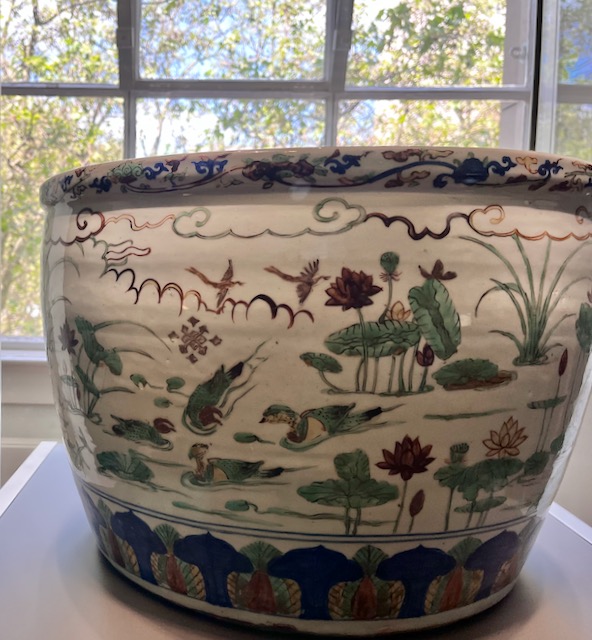
大きな金魚鉢、景徳鎮。明の13代皇帝 隆慶帝(治世は1567〜72年)の時代のもの。

Case 39
Vat for fish and aquatic plants 景徳鎮 金魚鉢 明の13代皇帝 隆慶帝(治世は1567〜72年)
The Longqing emperor ruled for just six years (AD 1567–72). During his reign, the imperial kilns were supervised by a succession of local magistrates with no official remaining in post for very long. Jingdezhen suffered severe flooding during the Longqing emperor’s reign and in AD 1571 the kilns were devastated by fire. Potters fired this large vat twice, painting some of the design in underglaze blue and then firing it again with overglaze red, yellow, aubergine and green to complete the design. Such vats would have been used as fish tanks and to grow water plants at the Longqing emperor’s court. Scenes of ducks swimming on a river, or in a pond, are shown on one side. Herons are shown preening themselves on the other with lotus and other water plants between. Jingdezhen, Jiangxi province, Ming dynasty, Longqing mark and period, AD 1567–72
PDF 778
明の永楽帝の時代(在位1402-1424年)の白磁、青の染付で鳥のつがいを描いた抱月瓶 。
Case 56
Yongle blue-and-white
Potters at Jingdezhen made the finest blue-and-white porcelains for the Yongle emperor (AD 1403–24). These have a lustrous quality never before accomplished and never successfully imitated.
The best designs were inspired by contemporary or earlier court painting styles, found in intimate art formats such as fans, album leaves and handscrolls.
Bottle with a pair of birds
This 抱月瓶 (bao yue ping ‘moon flask’) has a flattened circular body, cylindrical neck and cloud-shaped handles. Under strict court supervision, potters painted a design of a bird perched on a winter-flowering prunus branch (without leaves) on one side. On the other side is a second bird on a different flowering branch, accompanied by bamboo.
Jingdezhen, Jiangxi province, AD 1403–24


Bottle with butterflies and lilies
Potters painted flowering daylily plants on either side of this 玉壺春瓶 ( yuhuchun ping ‘pear-shaped bottle’), each with a butterfly hovering above. In China, heavily perfumed lilies traditionally symbolise harmony and unity. Daylilies and butterflies represent a good wish for fertility. Their naturalistic depiction here is influenced by ink and colour small-format paintings. The design is extremely rare among surviving Chinese porcelains and very skilfully executed. Each blade-like leaf and petal edge is outlined with a denser blue and in-filled with a paler blue wash. Similarly, gradations of blue are achieved in the depiction of the butterfly.
This extraordinarily accomplished control of the underglaze cobalt pigment is a characteristic of the finest Yongle blue-and-white wares.
Jingdezhen, Jiangxi province, AD 1403–24
 Sachan in Europe agrandie