Absolument impressionnant, la collection, mais on a encore trouvé des oeuvres ultra célèbres!!
Quel bonheur!
まだまだあった、きわめつけは、こちらです!!
奥まった暗い小部屋にひっそりとあったレオナルドダヴィンチの作品
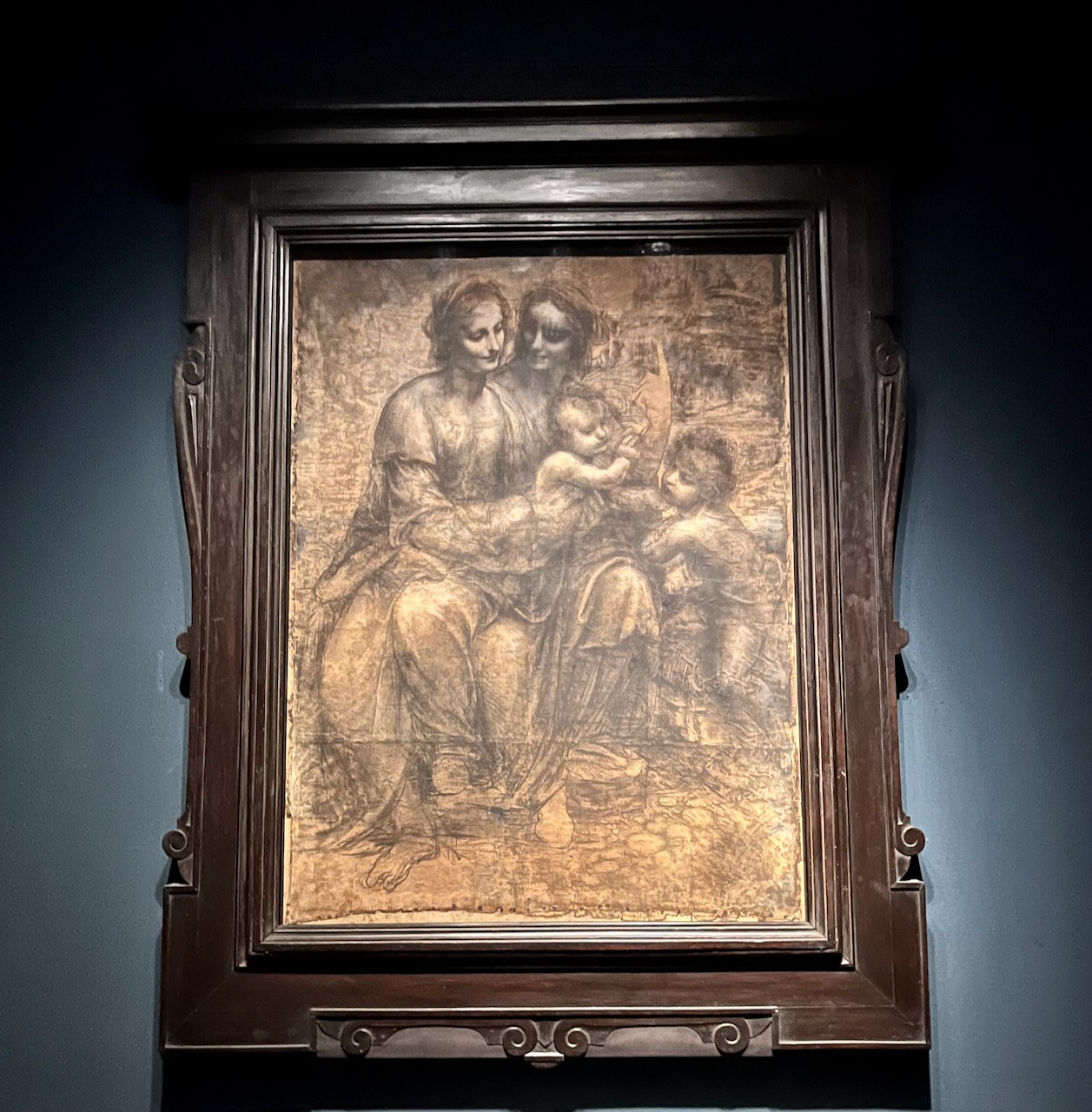
The Burlington House Cartoon Leonardo da Vinci
(National Galleryの解説より。)Drawing was a crucial part of Leonardo’s artistic process and he produced numerous small-scale studies of animals, human anatomy and landscapes. In fact, we know more about Leonardo as an artist from his drawings than from his paintings, as so few of those survive. This work is particularly important as it is the only surviving large-scale drawing by the artist. Unlike his studies, it is a highly finished composition, and it may be the only record we have of a now-lost painting.
Sheets of paper this large did not exist when Leonardo was alive, so he joined numerous pieces together – the joins are apparent on close inspection. Parts of the drawing are highly finished while other areas, like Anne’s pointing hand, were simply left as outlines. This shows us how Leonardo began by creating rough outlines of the shapes of parts of the body and then, using light and shade, gradually built them up into more rounded shapes. Parts of the drawing are densely shaded and contrasted with lighter areas to give a three-dimensional effect (a technique known as chiaroscuro), for example the figures‘ faces and elements of the draperies such as sections of the Virgin’s sleeve and the folds of fabric which cover Saint Anne’s knees.
In order to avoid harsh lines Leonardo blurred the contours of the forms, and the resulting smoky effect is called sfumato. He used it in his paintings too, for example The Virgin with the Infant Saint John the Baptist adoring the Christ Child accompanied by an Angel (’The Virgin of the Rocks‘). Around the eyes, this blurring produces a mysterious effect that intensifies the gazes of the figures, expressing Leonardo’s idea that the thoughts (moti mentali, or ’motions of the mind‘) of painted figures should be visible on their faces. As she points upwards, Saint Anne reveals the mystery of Christ’s being – he is both human and divine. The focus on her eyes, which are so deeply in shadow, seems to emphasise his extraordinary identity.
This is a cartoon, a large drawing usually made in preparation for a painting. When finished, the design would have been transferred onto the panel or canvas by pricking holes in the outlines and dusting over them with charcoal. However, this drawing, often referred to as ’The Burlington House Cartoon‘, shows no evidence of having been transferred, which suggests that no painting was made from this design. But it has been connected to a number of Leonardo’s commissions.(…)
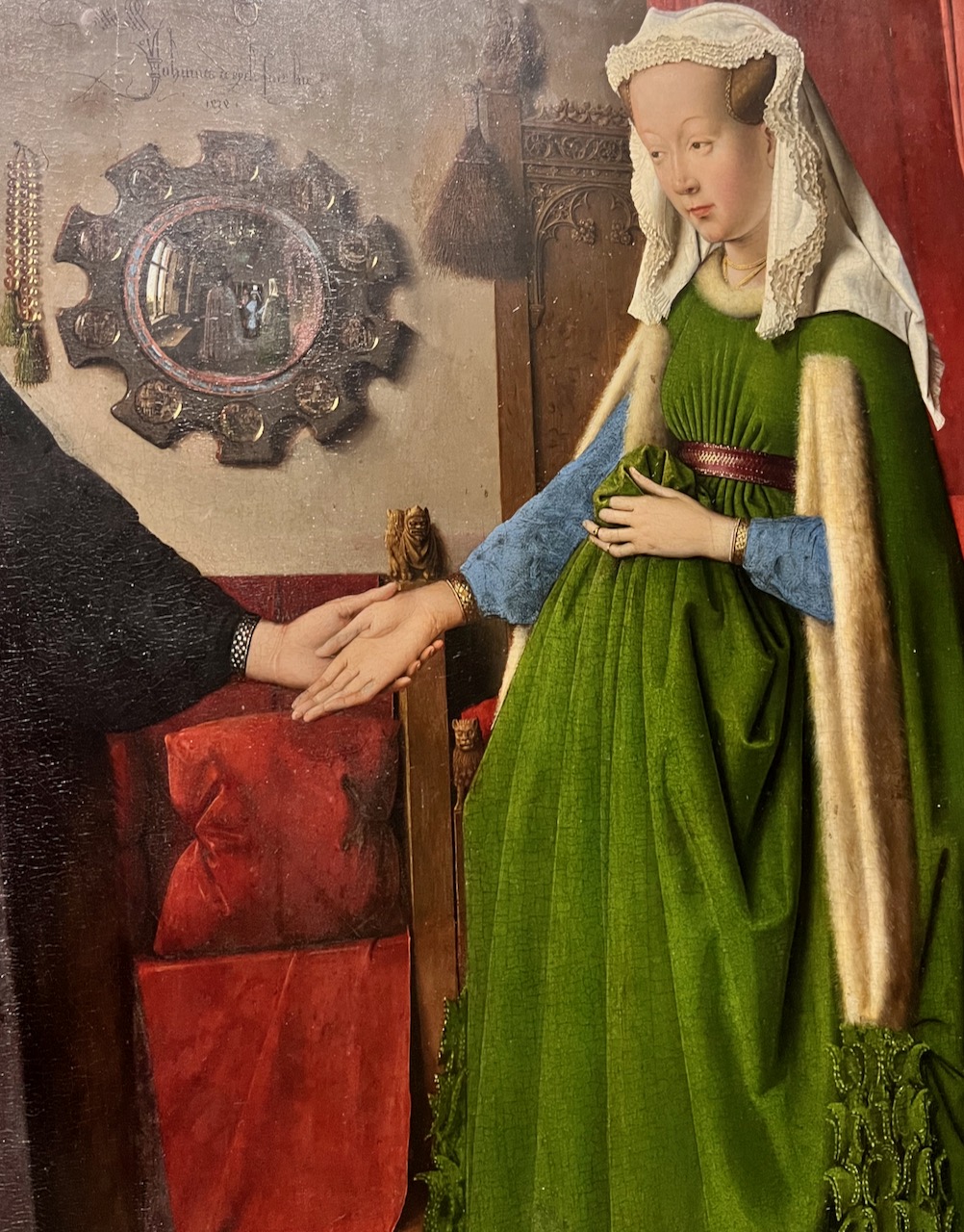
そして大好きなファンアイクの作品。Jan van Eyck (active 1422; died 1441) The Arnolfini Portrait, 1434

(National Galleryの解説より。)
This must be one of the most famous and intriguing paintings in the world. A richly dressed man and woman stand in a private room. They are probably Giovanni di Nicolao di Arnolfini, an Italian merchant working in Bruges, and his wife.
Although the room is totally plausible – as if Jan van Eyck had simply removed a wall – close examination reveals inconsistencies: there’s not enough space for the chandelier, and no sign of a fireplace. Moreover, every object has been carefully chosen to proclaim the couple’s wealth and social status without risking criticism for aping the aristocracy.
The man’s hand is raised, apparently in greeting. On the back wall, a large convex mirror reflects two men coming into the room, one of whom also raises his arm. Immediately above it is Van Eyck’s signature. ‘Jan van Eyck was here’.
Could the man in mirror be van Eyck himself, with his servant, coming on a visit?

ラファエロ
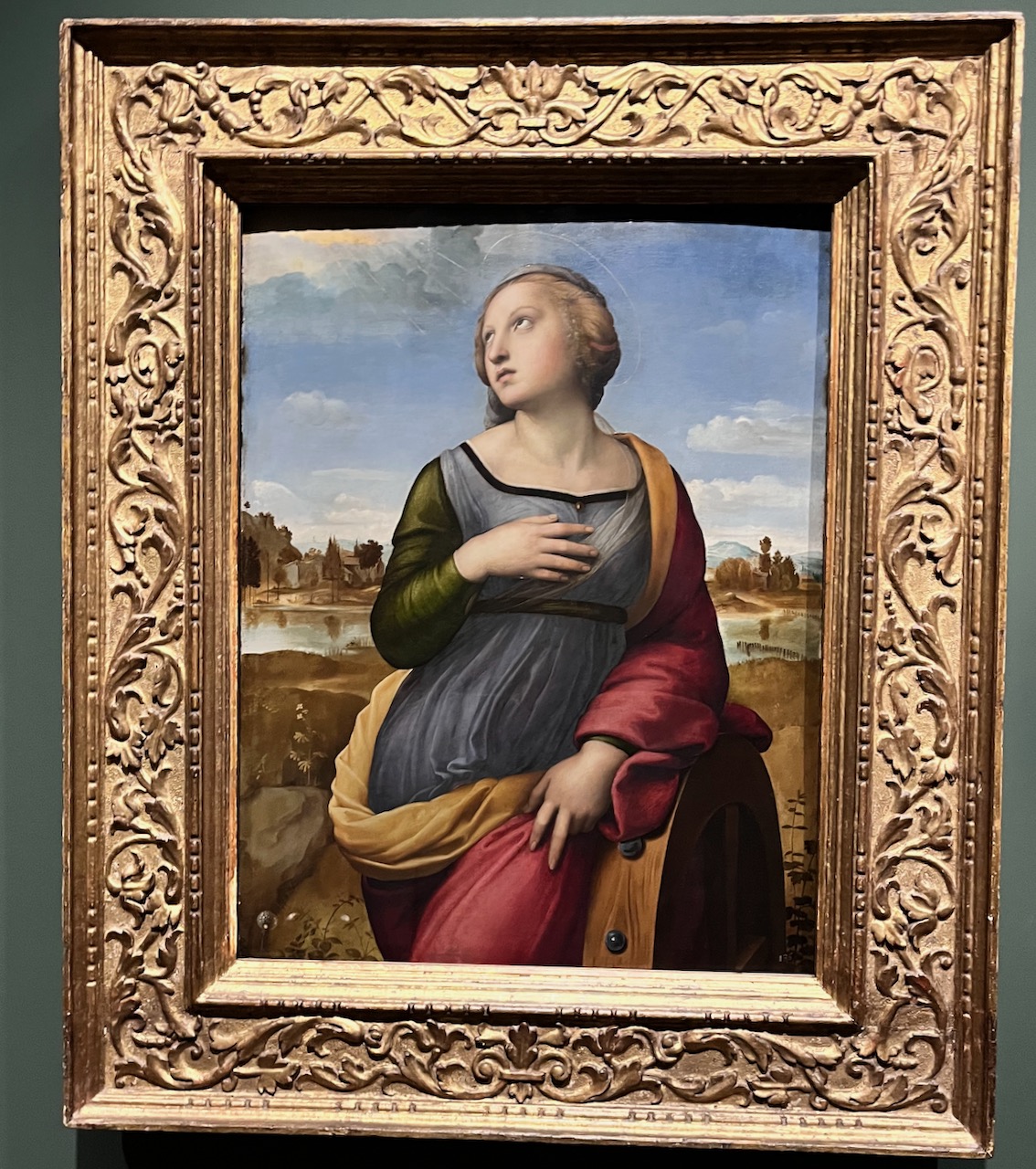
アレクサンドリアの聖カタリナ
1507年頃に制作されたもの。
レオナルド・ダヴィンチとミケランジェロの影響を受けながらもラファエロが自分自身の芸術に昇華した作品」なのだそうです。
もっと美術史を勉強して、じっくり見に行ったら、楽しいでしょうねー!
Saint Catherine of Alexandria
Raphael
Saint Catherine of Alexandria Raphael
Catherine of Alexandria, a fourth-century princess, was converted to Christianity and in a vision underwent a mystic marriage with Christ. When she would not give up her faith, Emperor Maxentius ordered that she be bound to a spiked wheel and tortured to death. However, a thunderbolt destroyed the wheel before it could harm her. Catherine was then beheaded.
Raphael has focused on the visionary aspect of the saint’s faith, capturing her with her hand on heart and her lips parted, in a moment of divine ecstasy looking heavenwards to a golden break in the clouds. In the foreground is a dandelion seed head. The dandelion often appears in Netherlandish and German paintings as a symbol of Christian grief and the Passion (Christ’s torture and crucifixion).
The saint’s twisting pose reflects Raphael’s study of the sinuous grace of Perugino’s paintings, the dynamic compositions of Leonardo and the monumentality of Michelangelo’s figures.
 Sachan in Europe agrandie